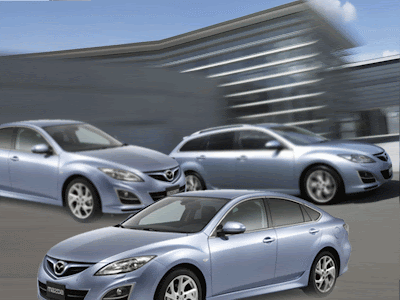
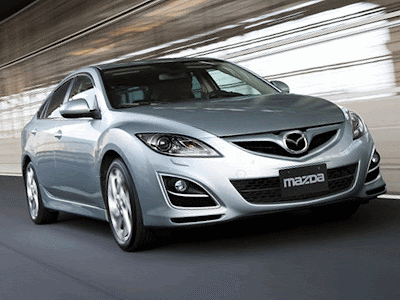
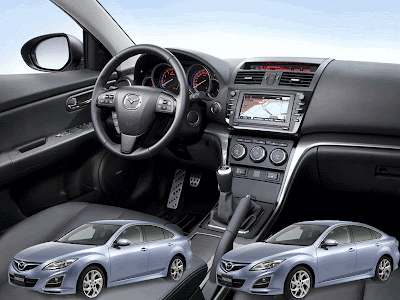
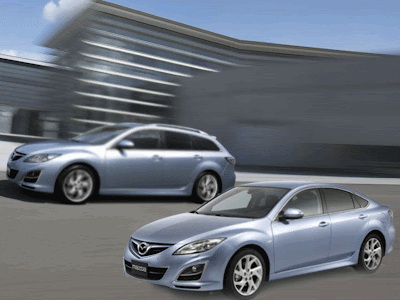
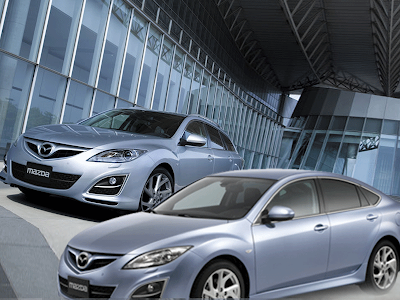
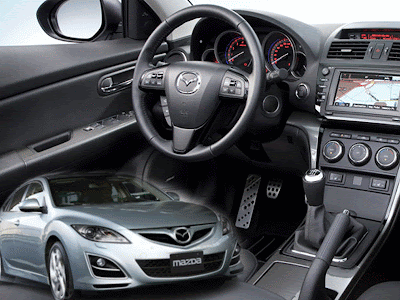
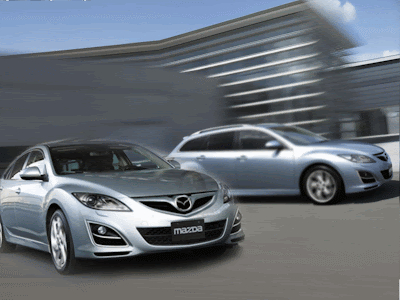
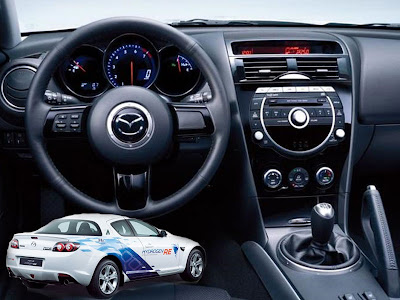
2010 Mazda Sport Cars Coupe Shinari Concept Car
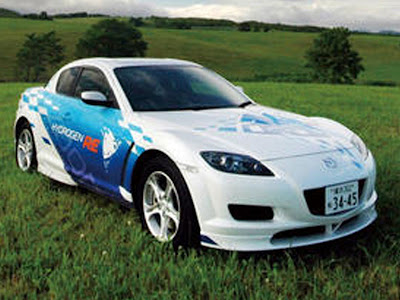
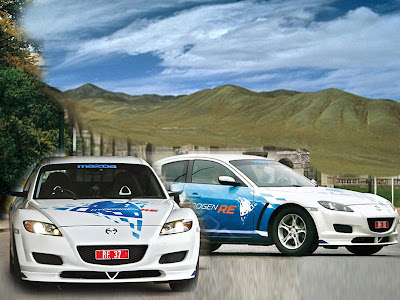
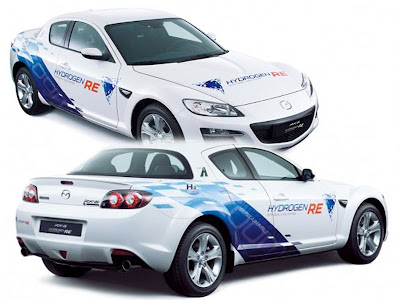
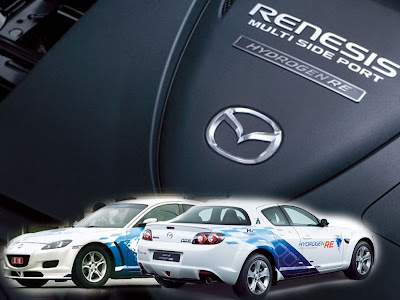
2009 Mazda Sports Car RX-8 Hydrogen RE vehicle with Norwegian specifications in HyNor
Mazda RX-2
The Mazda RX-2 was a midsize car introduced in 1970 and sold through 1978. It used a rotary engine and shared a chassis with the piston-engined Mazda Capella/616/618.
The RX-2 was really an option package for the Capella, albeit one that included a powerful rotary engine. In fact, early RX-2s were simply badged "Capella" with a small "RE" or rotor shape in the grille. The RX-2 was intended as a rotary-powered family car, while the Mazda RX-3 would be the sporty coupé.
The first RX-2 (known as the Series I and II) were introduced in 1970 and replaced in 1974. They shared chassis of the Mazda Capella and used a 12A Wankel engine. They were a tremendous success due to their comparatively high power and performance. In 1970, output was 130 hp (97 kW) and 115 ft·lbf (156 Nm
RX-2 (USA)
The RX-2 was one of the first Mazda vehicles offered for sale in the United States, lasting from 1971 through 1974. It appeared just after the Familia-based Mazda R100, and distribution of both cars was initially limited to the West Coast.
American emissions modifications reduced the 12A engine's output to 120 hp (89 kW), slowing the car's acceleration to 60 mph (97 km/h) from 10 to 11.3 sec. Nevertheless, Road & Track magazine reviewed the car favorably, calling the engine "impressive" and "plenty torquey" and comparing it to a smooth straight-6. The car's suspension and brakes also pleased the reviewers, but they were less enthusiastic about the "notchy" 4-speed manual transmission. All in all, the contemporary reviewers considered the RX-2, priced around US$3,000, "a steal".
Early RX-2s had trouble with failure of the oil seals, causing excessive oil consumption and heavier exhaust. Another failure mode involved overheating of the O-ring side seals between sections of the side housing which introduced coolant into the combustion chamber, reducing available power and making the engine hard to start, and ultimately rendering the vehicle inoperable.[1] At first, Mazda fixed the engines under warranty, replacing the overheated seals with new ones of the same design. Later, they offered a better, redesigned set of seals but at a cost to the consumer of US$1,000 per engine.[2] This caused many Mazda RX-2 owners to abandon rather than repair their cars, accounting for the extreme rarity of these exotic, sporty sedans.
Racing success
The RX-2 was the first Wankel-powered car to be widely raced - the original Cosmo competed in just a single race. Car and Driver magazine and Racing Beat built an RX-2 race car in 1973 for the IMSA sedan series. With radically-enlarged ports (they were so large that a "bridge" of steel was required to keep the corner seals in place), the RX-2 produced 198 hp (148 kW) in racing trim.
The RX-2 took the pole in its first race, at Pocono, but did not finish the race due to a broken differential. Lime Rock was its third race, and the RX-2 claimed both the pole and the win. Another win came at Road Atlanta, even with a 300 lb (136 kg) lead weight handicap. The engine modifications were outlawed for 1974, but the RX-2 kept winning. Car and Driver lost interest in the car, but others continued to race it, and other RX-2 and RX-3 racers soon appeared.
The RX-2 rotary engine (Wankel) suffered from rotor tip wear that the company was unable to correct until late 1974. RX-2s that experienced this rotor tip wear would have reduced power, thus impacting the driving experience.
Manufacturer Mazda
Production 1970–1978
Class Midsize
Body style(s) 2-door coupé
4-door sedan
Layout FR layout
Engine(s) 12A
12B
Wheelbase 2464 mm (97.s in)
Length 4140 mm (163 in)
Width 1575 mm (62.2 in)
Curb weight 1050 kg (2315 lb)
Related Mazda Capella/616/618
SOURCE: http://en.wikipedia.org/wiki/Mazda_RX-2
The RX-2 was really an option package for the Capella, albeit one that included a powerful rotary engine. In fact, early RX-2s were simply badged "Capella" with a small "RE" or rotor shape in the grille. The RX-2 was intended as a rotary-powered family car, while the Mazda RX-3 would be the sporty coupé.
The first RX-2 (known as the Series I and II) were introduced in 1970 and replaced in 1974. They shared chassis of the Mazda Capella and used a 12A Wankel engine. They were a tremendous success due to their comparatively high power and performance. In 1970, output was 130 hp (97 kW) and 115 ft·lbf (156 Nm
RX-2 (USA)
The RX-2 was one of the first Mazda vehicles offered for sale in the United States, lasting from 1971 through 1974. It appeared just after the Familia-based Mazda R100, and distribution of both cars was initially limited to the West Coast.
American emissions modifications reduced the 12A engine's output to 120 hp (89 kW), slowing the car's acceleration to 60 mph (97 km/h) from 10 to 11.3 sec. Nevertheless, Road & Track magazine reviewed the car favorably, calling the engine "impressive" and "plenty torquey" and comparing it to a smooth straight-6. The car's suspension and brakes also pleased the reviewers, but they were less enthusiastic about the "notchy" 4-speed manual transmission. All in all, the contemporary reviewers considered the RX-2, priced around US$3,000, "a steal".
Early RX-2s had trouble with failure of the oil seals, causing excessive oil consumption and heavier exhaust. Another failure mode involved overheating of the O-ring side seals between sections of the side housing which introduced coolant into the combustion chamber, reducing available power and making the engine hard to start, and ultimately rendering the vehicle inoperable.[1] At first, Mazda fixed the engines under warranty, replacing the overheated seals with new ones of the same design. Later, they offered a better, redesigned set of seals but at a cost to the consumer of US$1,000 per engine.[2] This caused many Mazda RX-2 owners to abandon rather than repair their cars, accounting for the extreme rarity of these exotic, sporty sedans.
Racing success
The RX-2 was the first Wankel-powered car to be widely raced - the original Cosmo competed in just a single race. Car and Driver magazine and Racing Beat built an RX-2 race car in 1973 for the IMSA sedan series. With radically-enlarged ports (they were so large that a "bridge" of steel was required to keep the corner seals in place), the RX-2 produced 198 hp (148 kW) in racing trim.
The RX-2 took the pole in its first race, at Pocono, but did not finish the race due to a broken differential. Lime Rock was its third race, and the RX-2 claimed both the pole and the win. Another win came at Road Atlanta, even with a 300 lb (136 kg) lead weight handicap. The engine modifications were outlawed for 1974, but the RX-2 kept winning. Car and Driver lost interest in the car, but others continued to race it, and other RX-2 and RX-3 racers soon appeared.
The RX-2 rotary engine (Wankel) suffered from rotor tip wear that the company was unable to correct until late 1974. RX-2s that experienced this rotor tip wear would have reduced power, thus impacting the driving experience.
Manufacturer Mazda
Production 1970–1978
Class Midsize
Body style(s) 2-door coupé
4-door sedan
Layout FR layout
Engine(s) 12A
12B
Wheelbase 2464 mm (97.s in)
Length 4140 mm (163 in)
Width 1575 mm (62.2 in)
Curb weight 1050 kg (2315 lb)
Related Mazda Capella/616/618
SOURCE: http://en.wikipedia.org/wiki/Mazda_RX-2
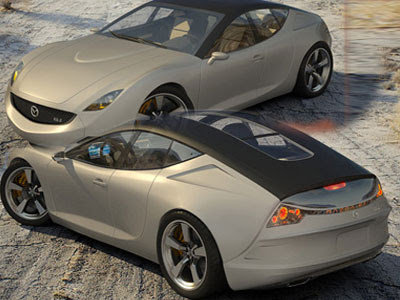
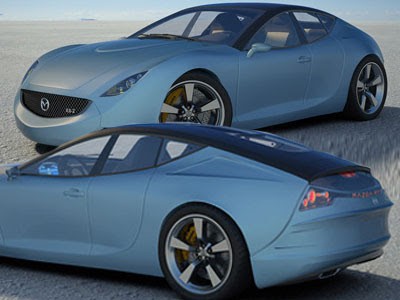
Mazda RX-Z Concept 3.0 litre V6 and two electric motors Sports Car Coupe.
The Mazda RX-Z concept is a proposal for a 2+2 sports coupe to replace the aging Mazda RX-8. The design was conceived by Andrus Ciprian, a design student from Romania whose previous work includes the Dacia MC concept. Like the MC the RX-Z concept was created using the 3d modeling program 3D Studio Max, and rendered with the help of Mental Ray.
Mazda RX-Z Concept Sports Car Coupe
The RX-Z was developed as Ciprian puts it; "as a link between fossil fuel cars and more ecological ones." To achieve this the proposed drivetrain for the concept includes a 3.0 litre V6 diesel engine up front - which replaces the notoriously thirsty rotary engine from the RX-8. And a pair of electric motors at the rear. Under normal conditions the RX-Z would be driven solely by the diesel engine. But at low speeds around town the electric drive can be used on its own for emission free motoring. At higher speeds the electric motors work in conjunction with the V6 engine to provide a boost function. A start/stop technology which is integrated into the engine further increases fuel efficiency.
One of the more unusual features of the Mazda RX-Z concept is the rear light panel. In the middle is a display screen which can light up with any text written by the driver. Presumably you can only 'write' on the back of your car when stopped, otherwise this would be one surefire way of either getting in a crash or getting in trouble!
The Mazda RX-Z concept is a proposal for a 2+2 sports coupe to replace the aging Mazda RX-8. The design was conceived by Andrus Ciprian, a design student from Romania whose previous work includes the Dacia MC concept. Like the MC the RX-Z concept was created using the 3d modeling program 3D Studio Max, and rendered with the help of Mental Ray.
Mazda RX-Z Concept Sports Car Coupe The RX-Z was developed as Ciprian puts it; "as a link between fossil fuel cars and more ecological ones." To achieve this the proposed drivetrain for the concept includes a 3.0 litre V6 diesel engine up front - which replaces the notoriously thirsty rotary engine from the RX-8. And a pair of electric motors at the rear. Under normal conditions the RX-Z would be driven solely by the diesel engine. But at low speeds around town the electric drive can be used on its own for emission free motoring. At higher speeds the electric motors work in conjunction with the V6 engine to provide a boost function. A start/stop technology which is integrated into the engine further increases fuel efficiency.
RX-Z concept is equipped with four doors. The rear doors are half-sized and hinged at the rear. This helps to disguise them into the bodywork and reduce their impact on the flowing lines of the car.
Mazda RX-Z Concept Sports Car Coupe
Mazda RX-Z Concept Sports Car Coupe One of the more unusual features of the Mazda RX-Z concept is the rear light panel. In the middle is a display screen which can light up with any text written by the driver. Presumably you can only 'write' on the back of your car when stopped, otherwise this would be one surefire way of either getting in a crash or getting in trouble!
Mazda RX-Z Concept 3.0 litre V6 and two electric motors Sports Car Coupe.
The Mazda RX-Z concept is a proposal for a 2+2 sports coupe to replace the aging Mazda RX-8. The design was conceived by Andrus Ciprian, a design student from Romania whose previous work includes the Dacia MC concept. Like the MC the RX-Z concept was created using the 3d modeling program 3D Studio Max, and rendered with the help of Mental Ray.
Mazda RX-Z Concept Sports Car Coupe
The RX-Z was developed as Ciprian puts it; "as a link between fossil fuel cars and more ecological ones." To achieve this the proposed drivetrain for the concept includes a 3.0 litre V6 diesel engine up front - which replaces the notoriously thirsty rotary engine from the RX-8. And a pair of electric motors at the rear. Under normal conditions the RX-Z would be driven solely by the diesel engine. But at low speeds around town the electric drive can be used on its own for emission free motoring. At higher speeds the electric motors work in conjunction with the V6 engine to provide a boost function. A start/stop technology which is integrated into the engine further increases fuel efficiency.
One of the more unusual features of the Mazda RX-Z concept is the rear light panel. In the middle is a display screen which can light up with any text written by the driver. Presumably you can only 'write' on the back of your car when stopped, otherwise this would be one surefire way of either getting in a crash or getting in trouble!
The Mazda RX-Z concept is a proposal for a 2+2 sports coupe to replace the aging Mazda RX-8. The design was conceived by Andrus Ciprian, a design student from Romania whose previous work includes the Dacia MC concept. Like the MC the RX-Z concept was created using the 3d modeling program 3D Studio Max, and rendered with the help of Mental Ray.
Mazda RX-Z Concept Sports Car Coupe The RX-Z was developed as Ciprian puts it; "as a link between fossil fuel cars and more ecological ones." To achieve this the proposed drivetrain for the concept includes a 3.0 litre V6 diesel engine up front - which replaces the notoriously thirsty rotary engine from the RX-8. And a pair of electric motors at the rear. Under normal conditions the RX-Z would be driven solely by the diesel engine. But at low speeds around town the electric drive can be used on its own for emission free motoring. At higher speeds the electric motors work in conjunction with the V6 engine to provide a boost function. A start/stop technology which is integrated into the engine further increases fuel efficiency.
RX-Z concept is equipped with four doors. The rear doors are half-sized and hinged at the rear. This helps to disguise them into the bodywork and reduce their impact on the flowing lines of the car.
Mazda RX-Z Concept Sports Car Coupe
Mazda RX-Z Concept Sports Car Coupe One of the more unusual features of the Mazda RX-Z concept is the rear light panel. In the middle is a display screen which can light up with any text written by the driver. Presumably you can only 'write' on the back of your car when stopped, otherwise this would be one surefire way of either getting in a crash or getting in trouble!
Sponsored